Showing posts with label notes. Show all posts
Saturday, September 14, 2013

The French New Wave (1959-1964)

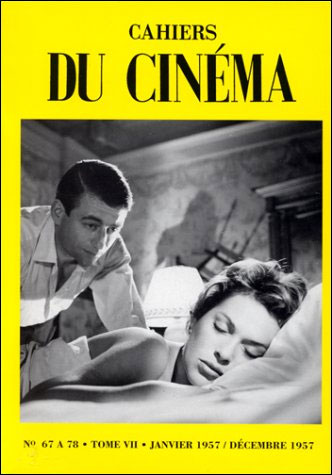
In the mid 1950s, a bunch of young men made a habit of attacking the most artistically respected French filmmakers of the day. And take note they wrote their criticisms on the influential french film magazine, Cahiers du Cinema.


We have Jean-Luc Godard who addressed the 21 major directors he asserted, "Your camera movements are ugly because your subjects are bad, your casts act badly because your dialogue is worthless; in a word you don't know how to create cinema because you no longer even know what it is". Francois Truffaut and Godard along with Claude Chabrol, Eric Rohmer and Jacques Rivette also praised directors considered somewhat outdated or eccentric.

"We were all critics before beginning to make films and I loved all kinds of cinema, the Russians, the Americans, the Neorealists. It was the cinema that made us or me, at least want to make films. I knew nothing of life except through the cinema" - Jean Luc Godard, director.

I really liked that quote from Director Godard. Giving criticisms aren't used just to insult but to bring out the best in you. Being criticized is not fun at all but at least, you'll know what you lack. You'll be aware since you've been told about the things you need to change. I believe that it's a very effective tool for us to be able to realize that we can be the best.

Writing criticism didn't satisfy these young men, they are hungry to make movies. They even started borrowing money from friends and filming on location to shoot their short movies. 


New wave films pushed further the Neorealist experimentation with plot construction. The films often lack goal-oriented protagonists. New Wave narratives often introduce startling shifts in tone, jolting our expectations. The New Wave films ends ambiguously. 

The New wave offered not only several original and valuable films but they also demonstrated that renewal in the film industry could come from talented, aggressive young people inspired in large part by the love of cinema.

The Italian Neorealism (1942-1951)


Italian Neorealism is a film movement by stories set amongst the poor and working class, using non-professional actors and filmed on location. Italian Neoralist films represents the economic difficulty in Italy during the world war II by portraying the conditions of everyday life and that includes poverty, desperation, injustice and oppression.

There is no definitive source for the term Neorealism but it was said that it first appeared in the early 1940s in the writings of Italian critics. Today most historians believe that Neorealist filmmaking was not a complete break with Italian cinema under Mussolini. The film White Ship (1941) by Roberto Rossellini, a pseudo-documentary prepared the way for more direct handling of contemporary events. The current trends that time such as regional dialect comedy and urban melodrama encouraged the directors and scriptwriters to turn towards realism and this trend later became known as the Neorealist movement.

Neorealism created a distinctive approach to film style. 

Shooting on the streets and in private buildings made Italian Camera operators skilled at cinematography that often avoided the three-point lighting system of Hollywood.

The movement exercised a strong influence on the individual filmmakers such as Ermanno Olmi and Satyajit Ray and on groups such as the French New Wave.

Before I end this post, this is the trailer of 'The Bicycle Thief'. A nice example of an Italian Neorealist film.


Soviet Montage(1924-1930)

(Screencap from 'The Extraordinary Adventures of Mr. West in the land of Bolsheviks)
Soviet Montage is actually an approach in cinema that relies heavily upon editing. 'montage' is the french word for 'assembly' or 'editing'. Minimizing the individual characters in the center of attention is one of the characteristics of Soviet Montage films. In here, single characters are being shown as members of different social classes and are representing a general type or class.

During the world war 1, there were a number of private production companies operating in Moscow and Petersburg. The companies did quite well making films for domestic marker with most imports cut off. These film companies resisted the movie made directly after the revolution to nationalize all private property. They just simply refused to supply films to theaters operating under the control of the government. The government's film section of the State Commission of Education put strict controls on the supplies of raw film stock and as a result, the producers started hoarding their stock and even the largest firms took all the equipment and fled to other countries.

But despite the shortages of equipment and difficult living conditions, some young filmmakers made their moves that would improve the development of a national cinema movement. We have Dziga Vertov and Lev Kuleshov that made their part to save what really has to be saved.

Dziga Vertov
Lev Kuleshov

The Soviet authorities encouraged all the filmmakers to create simple films that would be readily understandable to all audience. Stylistic experimentation or non-realistic subject matter was often criticized or censored.


Blog Template by BloggerCandy.com